

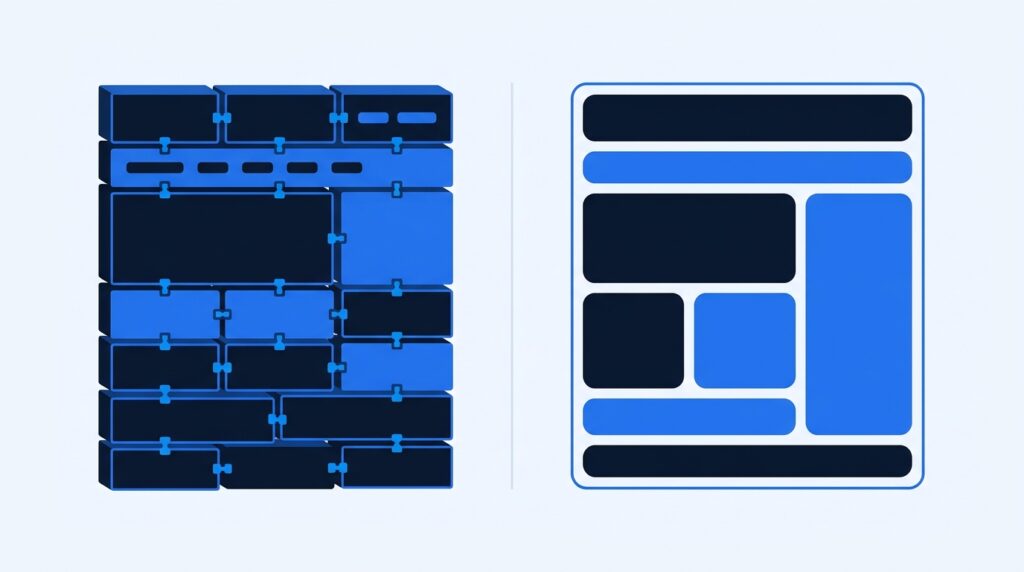
AI website builders changed what people expect from building a website.
You describe what you want, the software generates something, and you keep talking to it until the project starts looking right. That interaction is powerful because it removes a lot of the traditional friction between an idea and a working site.
I have used that approach myself. It is impressive.
I also came back to WordPress.
The reason is not that AI website builders are bad. It is that speed at the beginning and control over the long term are two different problems.
AI website builders win the first ten minutes
If your goal is to turn an idea into something visual quickly, an AI builder can feel almost unfair compared with starting from a blank WordPress installation.
You do not have to choose a theme, understand plugins or decide how every piece fits together before seeing progress.
That is a real advantage, and WordPress should learn from it.
WordPress wins differently
WordPress is not one product controlled by one website builder. It is an open platform with a massive ecosystem of themes, plugins, hosts and developers.
You can move the site. You can change hosts. You can replace one plugin with another. You can write your own functionality. You can connect services that the original site builder never planned for.
That flexibility sometimes creates more decisions. It is also the reason a WordPress site can keep changing long after the original build.
The real question is what happens after the first version
A generated landing page is not the same thing as a business platform.
What happens when you need memberships? A community? Affiliate tracking? Complex SEO controls? A custom workflow? A plugin that solves a niche problem? A different host? A developer who needs direct access to the code?
The more important your website becomes, the more those questions matter.
AI does not have to replace WordPress
This is the part I think gets missed.
The conversational experience of an AI website builder and the ownership model of WordPress do not have to be mutually exclusive.
WordPress has been building AI infrastructure of its own. The Abilities API gives WordPress functionality a standardized, discoverable interface. The official MCP Adapter can expose abilities to AI agents. WordPress 7.0 also added an AI Client that plugin developers can use without tying their plugin to one AI provider.
WordPress has published a practical developer tutorial showing how the Abilities API, AI Client and MCP Adapter can work together.
What if you could talk to WordPress too?
That is the idea that pulled me back toward WordPress.
I like being able to tell AI what I want. I do not want to give up WordPress, my plugins, my hosting and the ability to change the underlying system just to get that interface.
With an MCP connection, an AI assistant can be given tools that interact with the actual WordPress site.
That means the future does not have to be WordPress versus AI.
It can be WordPress controlled through AI.
Where AI website builders still make sense
There are plenty of projects where an AI builder is the right choice.
If you need to prototype an idea quickly, test an interface, build a small application or get something in front of users with minimal setup, the speed can be worth the tradeoffs.
The mistake is assuming that because one tool is faster at generating version one, it must also be the best home for the project five years later.
Where I prefer WordPress
I prefer WordPress when the website itself is going to become an asset I expect to keep expanding.
Content-heavy sites, SEO projects, membership sites, communities, affiliate systems and businesses that depend on a growing collection of integrations all benefit from having a platform that can be extended in many directions.
That is also why Marketur is built on WordPress.
If you want to see the more direct comparison from my own experience, read WordPress vs Lovable in 2026.
The interface is changing, not the need for ownership
I think AI website builders proved something important: people want to build and manage software by explaining what they want.
That interface is not going away.
But the winning interface does not necessarily have to own the platform underneath it.
WordPress can remain WordPress while AI becomes a much better way to work with it.
That is what I am exploring with Marketur MCP, and it is why I think WordPress has become more interesting again, not less.