
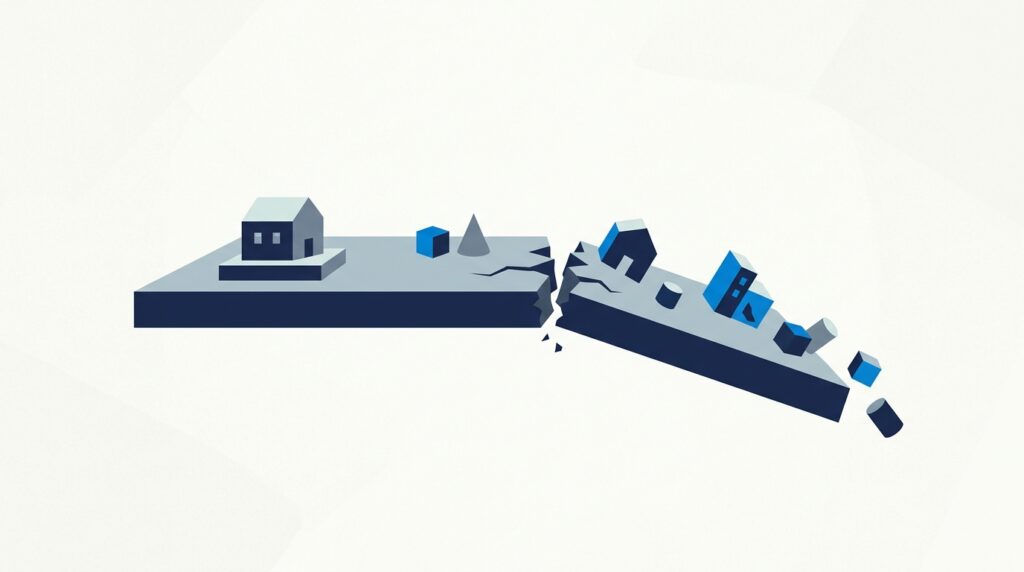
Every product I have watched die took somebody’s business down with it.
Not the big companies. The people who built on top of them. The developers whose apps stopped working, the creators whose audience lived somewhere that shut down, the businesses whose entire distribution ran through a platform that changed its mind.
I have been on the wrong end of this more than once, so this is not a theoretical warning.
What platform dependency actually costs
It is rarely the shutdown that gets you. It is the change in terms.
I have had an app held up for weeks over a login requirement, sitting in a review queue, unable to do anything except wait and refresh a dashboard wondering whether the submission had even registered. Nothing was wrong with the product. The rules had an opinion about it.
I have built with an AI platform and got it working, only to find the authorisation screen showed the platform’s name instead of my own product. My users, my domain, my idea, somebody else’s brand at the moment that mattered most.
I have spent hundreds of dollars burning through credits on builders where the pricing, the limits and the export options were all decisions somebody else got to make.
None of those were shutdowns. All of them were the same lesson: the part of your business you do not control is the part that will hurt you.
The graveyard is long
Google Stadia. Google Domains. Inbox by Gmail. Parse. Wunderlist. Revue. Pocket. Jawbone. Twitter’s API, which went from free and open to expensive and hostile and took a generation of third-party apps with it.
Every one of those had developers and businesses built on top of it. Every one of those looked permanent right up until the announcement. Parse was owned by Facebook. Stadia and Domains were owned by Google. Being owned by a large company is not the protection people assume it is – if anything it makes you easier to close, because you are a rounding error in somebody else’s portfolio review.
The questions worth asking before you build
If this platform doubled its price tomorrow, what happens to me? If the answer is that the business stops working, the price is not really under your control.
If it shut down with ninety days’ notice, could I move? Not in theory. Could you export your customers, your content and your data, and would any of it be usable somewhere else?
Who owns the relationship with my customer? If your audience only exists inside somebody else’s product, you do not have an audience. You have access to one, on loan.
What is the single point of failure? Most businesses have one. Knowing which it is beats pretending it does not exist.
This is why I came back to WordPress
I did not come back because WordPress is more fun. Parts of it are genuinely annoying.
I came back because the hosting is mine, the database is mine, the plugins are files I can read, the content exports, and nobody can change the pricing of my own site. When I got tired of an AI builder’s limits, the cost of leaving was a decision rather than a catastrophe.
That is the whole argument. Not that closed platforms are bad – plenty of them are excellent – but that you should know exactly what it would cost you to leave, and decide that with your eyes open rather than finding out during an outage.
You do not have to avoid platforms
You cannot build anything modern without depending on something. Payments, hosting, email, search, app stores. Avoiding all of it is not a strategy.
The goal is not independence. It is knowing where you are exposed, and making sure the exposure is a choice rather than a surprise.
Own the layer your customer relationship lives in. Get the email addresses. Keep a copy of your content somewhere you control. Treat anything you cannot export as rented.
Check this before you build, not after
Distribution risk is one of the things that kills otherwise good ideas, and it almost never shows up in the excitement of the first week.
The Marketur Reality Check looks at exactly this when it pressure-tests an idea: who controls your distribution, what happens if they change the terms, and what the cheapest test is that could kill the idea before you spend real money on it. Free, no account.
If you are earlier than that, how to validate a business idea before you spend money covers the rest of it.
I am not telling you to be paranoid. I am telling you that every single time this has cost me, the warning signs were available on day one and I was too excited to look at them.